BNAC PhD Researcher Ashley Tranquille Shares New Clues to MS Cognition at MSToronto2026

At the 10th Joint ACTRIMS–ECTRIMS Meeting (MSToronto2026) in Toronto, BNAC doctoral researcher Ashley Tranquille shared new findings on a question that matters deeply to people living with multiple sclerosis (MS): why do memory and thinking sometimes become more difficult, even when routine brain scans do not tell the whole story?
Ashley presented the poster “Perivascular alterations and relationship with cognitive impairment in people with multiple sclerosis,” highlighting a promising approach to looking beyond familiar MS lesions and exploring the tiny spaces surrounding blood vessels in the brain.
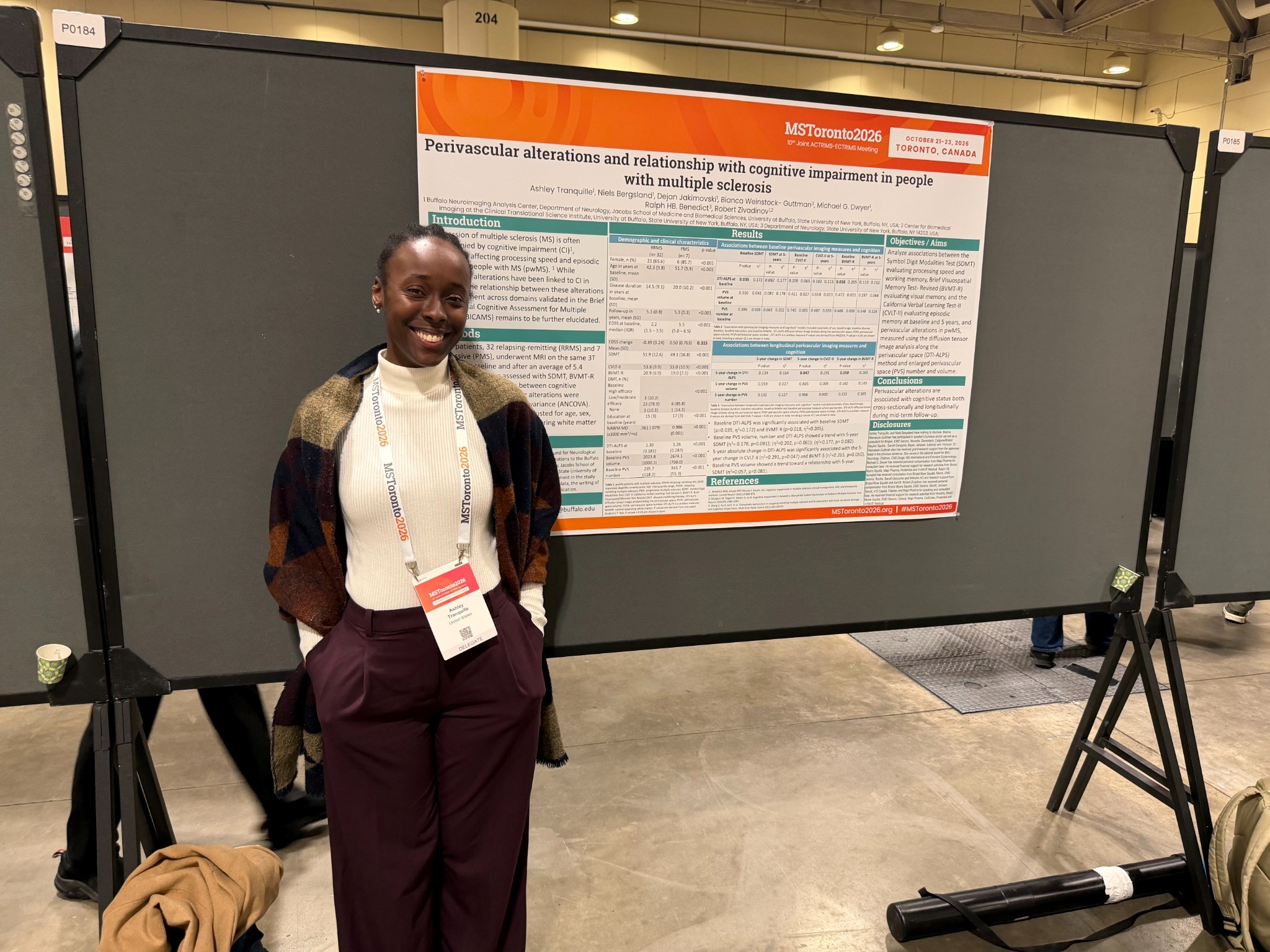
Ashley Tranquille with her cognitive research poster at MSToronto2026, Toronto.
A different window into brain health
Perivascular spaces are fluid-containing channels around small blood vessels. Researchers are studying how these spaces and related MRI measurements may reflect inflammation, tissue injury, or altered brain-fluid movement. Ashley’s research combines measurements of enlarged perivascular spaces (PVS) with a diffusion MRI approach called DTI-ALPS, which examines water movement near these pathways. These are emerging research measures, not established clinical tests or direct measurements of the brain’s waste-clearance function.
What the Toronto poster found
The cognitive study followed 31 people with MS who had MRI and cognitive assessments approximately 5.4 years apart. Baseline DTI-ALPS measurements were associated with performance on tests of information-processing speed and visual memory; changes in this MRI measure over time were also associated with changes on selected memory tests. The observations are preliminary, based on a relatively small group, and do not show that perivascular abnormalities cause cognitive impairment. They do, however, suggest another line of investigation for understanding symptoms that can affect employment, relationships, and everyday independence.
Part of a wider, three-year research effort
The Toronto poster is one part of Ashley’s PhD research at BNAC. Over the past three years, she and collaborators have examined how DTI-ALPS and PVS measurements relate to clinical disability, other MRI findings, cognition, blood-based protein biomarkers, and eye imaging. This sustained work has generated peer-reviewed publications and multiple scientific abstracts presented at international meetings.
In analyses involving 100 participants, the team investigated relationships between perivascular MRI measures and blood proteins linked to inflammation and neurological injury, including neurofilament light chain (NfL) and glial fibrillary acidic protein (GFAP). Another analysis, involving 73 people with MS, explored associations with optical coherence tomography (OCT), a quick, noninvasive test that images the retina. Additional longitudinal work has examined how perivascular markers relate to clinical progression and changes in brain lesions over several years.
Putting patients at the center
What makes this work especially interesting is the effort to connect different pieces of the MS experience: changes visible on MRI, how well a person can think and remember, what blood proteins suggest about underlying biology, and what can be learned from the eyes. No single imaging measurement can explain MS progression on its own. But studying these signals together may eventually help clinicians recognize meaningful disease changes earlier and tailor monitoring to the individual.
Ashley’s research is carried out with BNAC faculty and clinical collaborators, including Niels Bergsland, PhD, Michael G. Dwyer, PhD, Robert Zivadinov, MD, PhD, Ralph Benedict, PhD, and colleagues across the University at Buffalo and beyond. It was wonderful to see this thoughtful, patient-focused research represented in Toronto. BNAC congratulates Ashley on her contributions and looks forward to the next steps in this promising program.